Club Meeting: 17 June 2026
Report by: Kieran FitzGerald
Tonight Jon captured our attention by:
- demonstrating how to turn wood with a banana
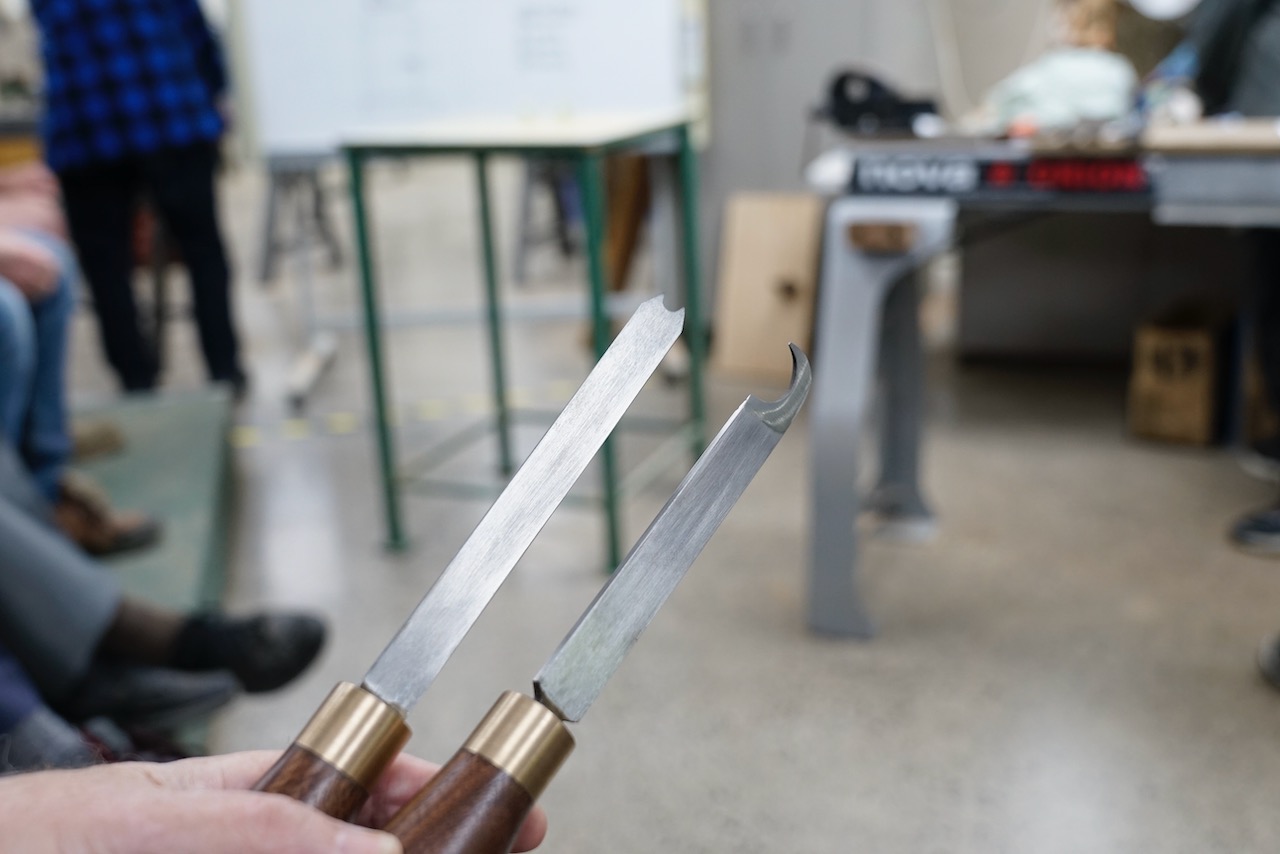
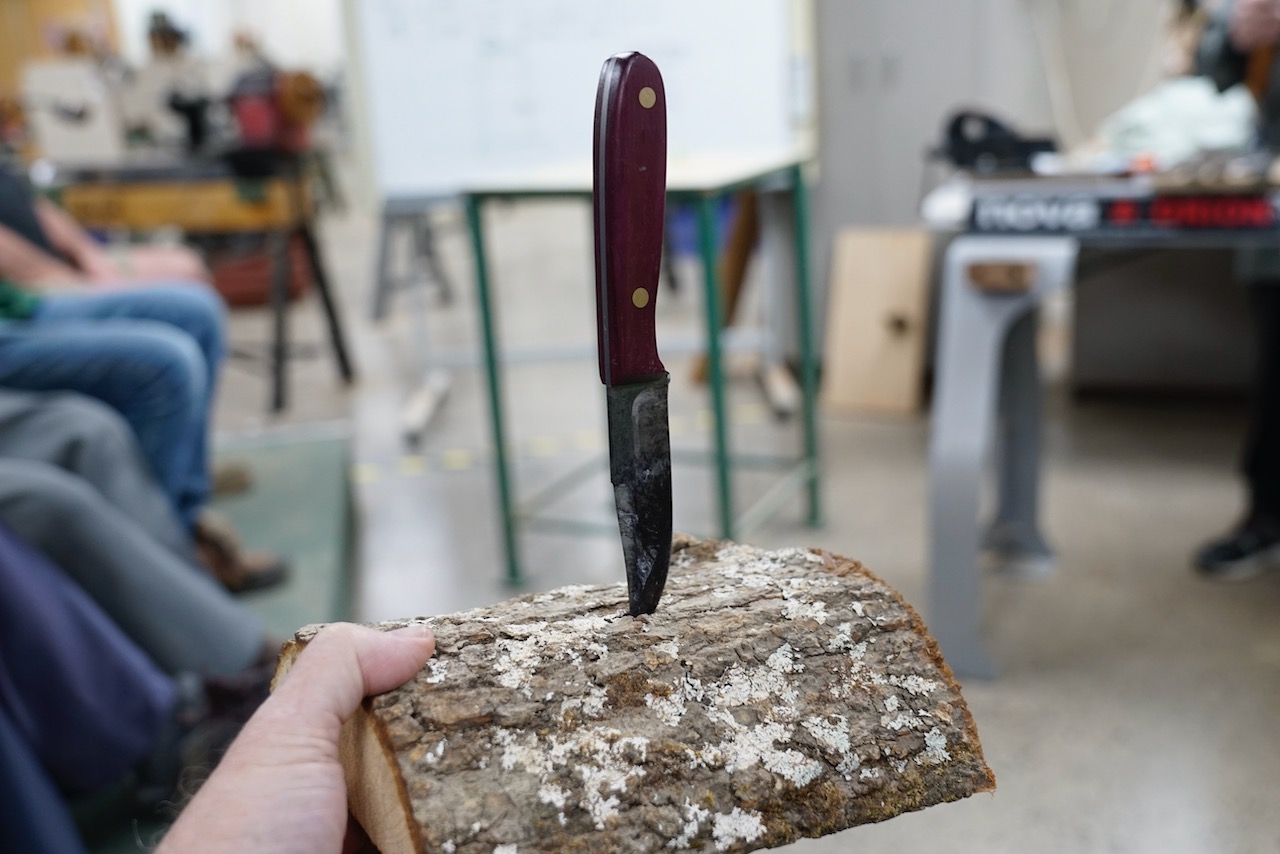
- exhibiting several beautifully crafted woodturning tools that he had made at home, including two scrapers, a skew, a parting tool, a knife and two captive ring tools.
However the tone of the evening changed as Jon morphed into mad scientist mode and delivered a full on lesson on metallurgy as it relates to various types of steel. Let’s unbundle some of what he told us and try and make sense of it.
The underlying theme throughout the presentation was making woodturning tools at home. But first there are some basics to understand.
What is steel? Jon advised that while iron is the key component of tool steels, carbon the element is an important component which determines its hardness and therefore its suitability for tool making.
| Type Of Steel: | Iron (Fe) | Wrought Iron | Low Carbon Steel e.g. 1018 | Medium Carbon Steel e.g. 1045 | High Carbon Steel e.g. 1095 | Cast Iron |
| % of Carbon: | 0% | Up to 0.03% | Up to 0.3% 1 HRC | 0.3 – 0.6% 10-55 HRC | 0.6 – 2.0% 11-66 HRC | 2 – 4% |
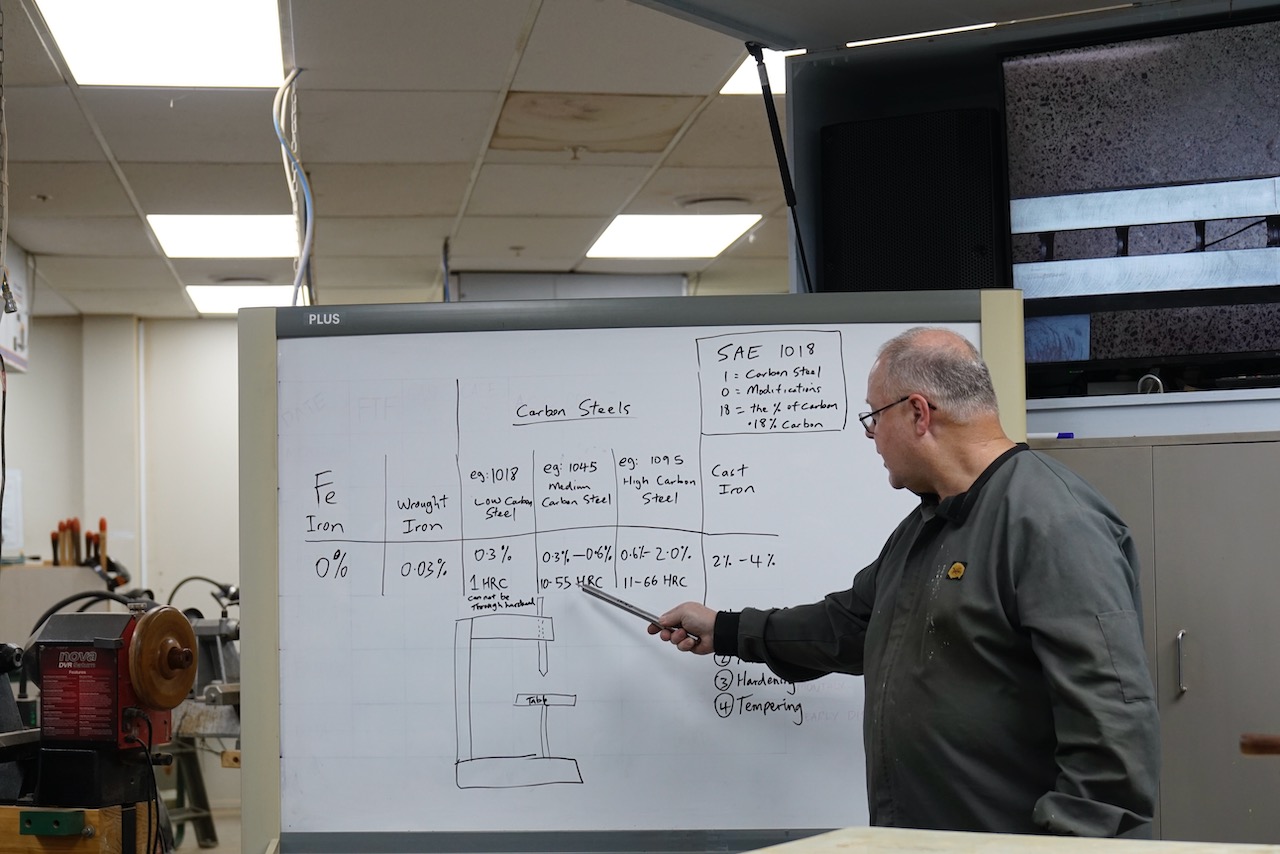
Simply put, the more carbon the harder the steel can be made by heat treatment processes. The Rockwell scale is used to measure the hardness of steel, expressed in terms of HRC. For example 1095 steel is purchased in an annealed (soft) state which is around 11 HRC. However it can be hardened up to 6 times that hardness with heat treatment processes. 1095 is a good candidate for making woodturning tools.
How do you know what type of steel you have? Compared to identifying wood, it is very hard to identify unknown steel that you have found under the bench in the workshop. A metal analyser costs between $30,000 – $60,000 and is out of reach for home users. A magnet will stick to carbon steels, but it can also stick to some stainless steels. A spark test can be used to get an idea if a piece of steel has high or low carbon content. When putting steel to the grinding wheel, a low carbon steel produces longer, quite straight sparks, while a high carbon steel produces sparks that burst and fork like fireworks. That would indicate a higher carbon content, but it will not tell you the actual percentage of carbon in the steel. For that reason it is recommended to source your steel by name from a known steel company.
What is heat treating? Whilst the amount of carbon determines how hard a piece of steel can be hardened, too much carbon (over 2%) would move it into the category of cast iron. Cast iron may be hard, but it is not tough. In fact it is quite brittle, and therefore unsuitable for making woodturning tools.
When making tools you need to consider both hardness and toughness. The hardness of steel is altered through a heat treatment process called hardening. The steel is brought to a specific temperature where it becomes non-magnetic, and then cooled rapidly. This process makes the steel very hard, but it also becomes very brittle. Another heat treating process called tempering is required to take away some of the brittleness and to give the steel more toughness.
Jon talked about four heat treating processes:
- Normalising returns the steel’s grain structure to its normal state. For example, steel from a blacksmith’s forge is hammered into a particular shape. During that process the grain in the steel becomes ununiformed in size. To normalise the steel it is heated close to its hardening temperature and then air cooled. This creates a uniform grain structure and relieves the internal stresses caused during fabrication.
- Annealing is similar process to normalising but the steel is usually cooled very slowly in the forge once the heat is turned off. Annealing makes the steel soft so that it can be easily worked, shaped and drilled if required.
- Hardening involves heating the steel to a high temperature where it becomes non-magnetic. Then the steel is cooled rapidly by quenching in solution of water, brine or oil. This locks the carbon into the iron’s grain structure making it very hard, but very brittle. The cooling solution depends on what type of steel you are hardening.
- Tempering is an important process which takes away some of the brittleness and gives the steel more toughness. With tempering, the steel is held at a set temperature (200C) for two hours and then air cooled.
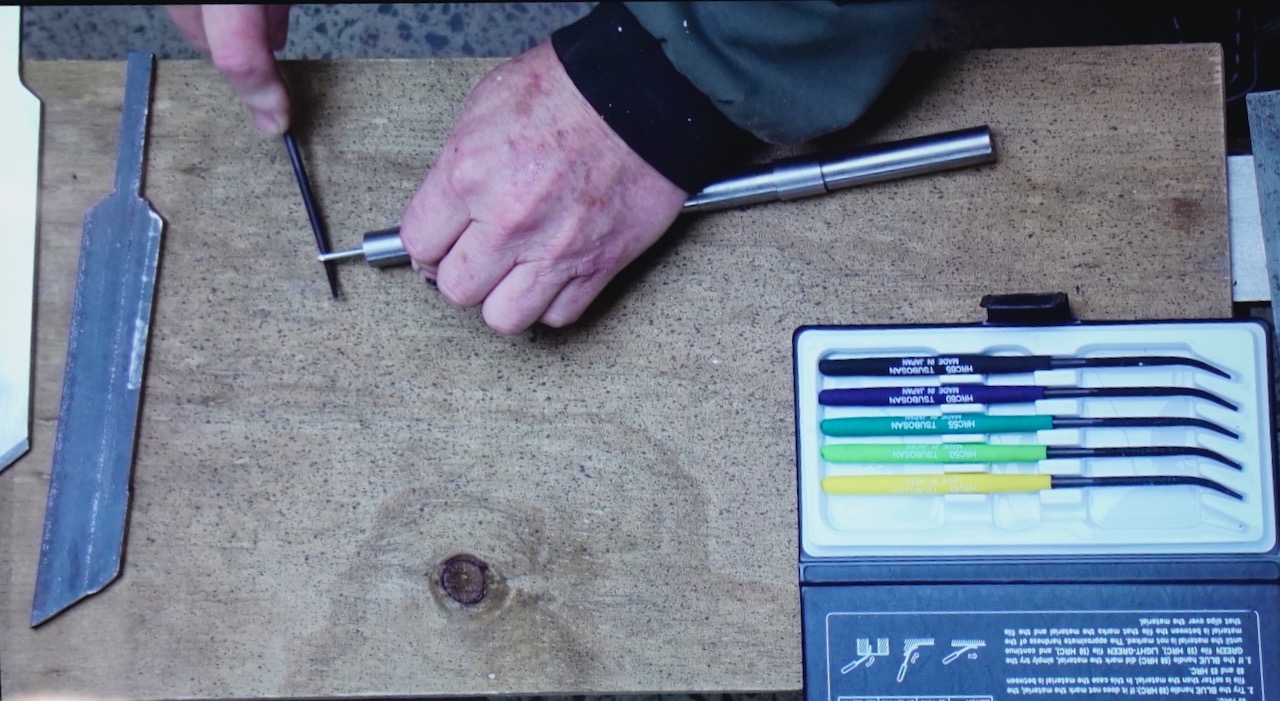
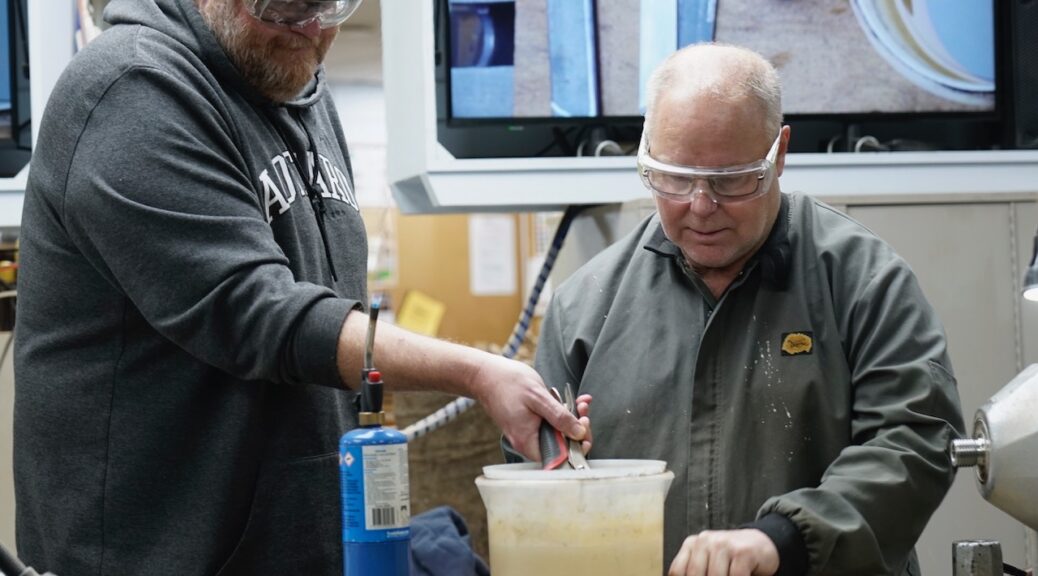
Jon used an HRC hardness testing file set to do a scratch test on a sample piece 1045 steel rod. He heated the tip of the rod with a gas torch until it was cherry red (at which point it became non-magnetic). Before heat treating, the HRC40 file could cut into the rod, showing that the rod was lower than HRC40. But after the heat treatment process the rod tested between 55 and 60 HRC with the files.
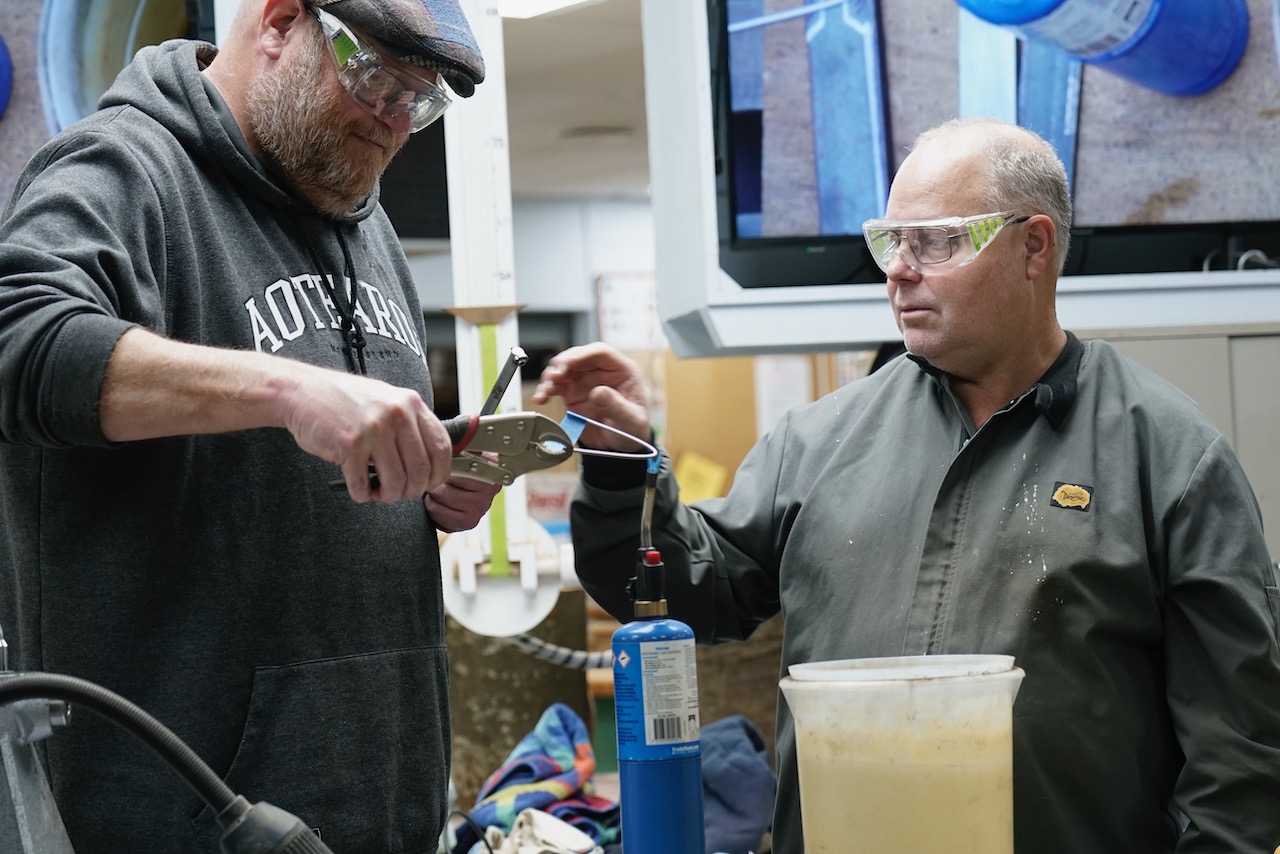
Jon also demonstrated with de-galved fencing wire how the qualities of the wire were affected by different heat treatment processes. Wire samples were heat treated to show the normalising, hardening and tempering processes. Unfortunately the piece for the tempering process did not work well and while his assistant should have struggled to straighten out the wire, he broke the wire in half. The wire broke where there were no temper colours and therefore it was still brittle in that area.
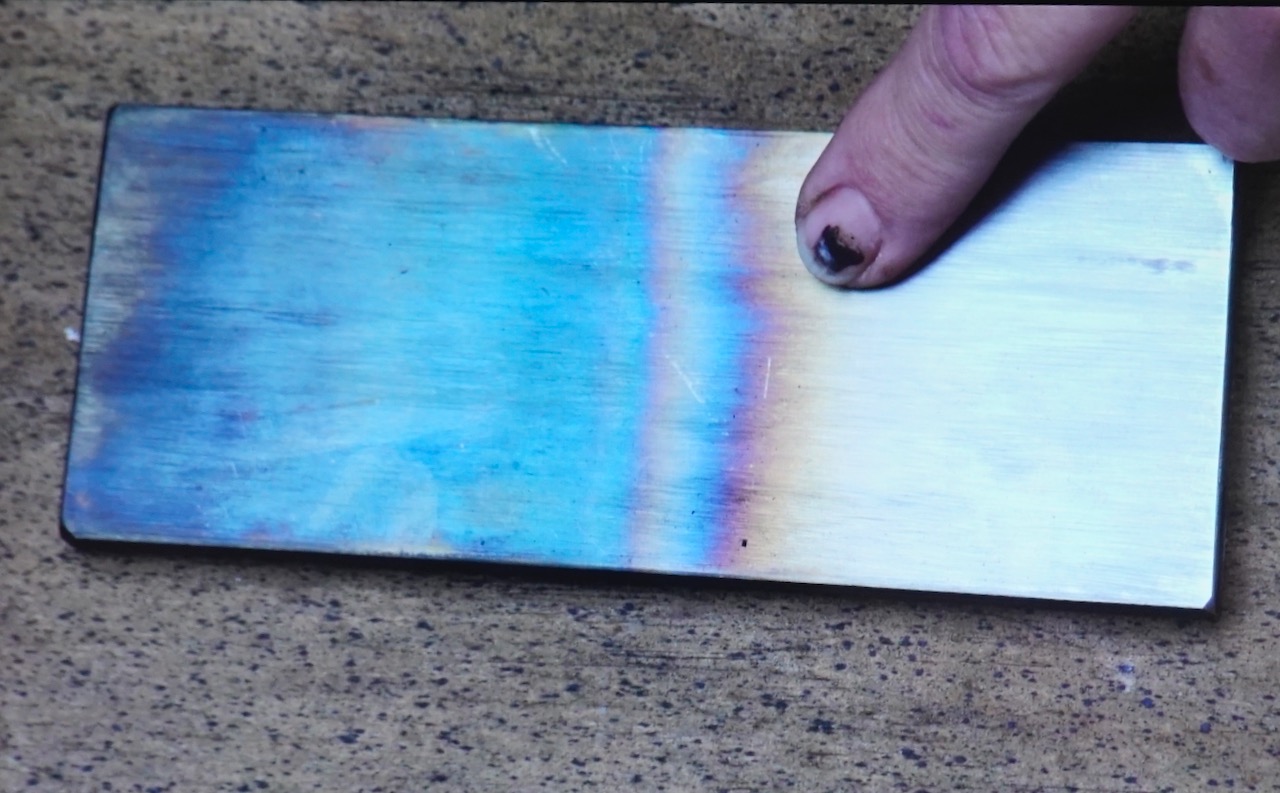
Steel responds to heat by changing its colour as it gets hotter. Jon showed us a piece of flat steel plate which he had heated earlier and the temperature colours ranged from straw (around 200 degrees C) through to grey (above 350 degrees C). Each colour change occurs at a definable temperature. During the tempering processes the temperature can be observed by the straw colour of the steel.
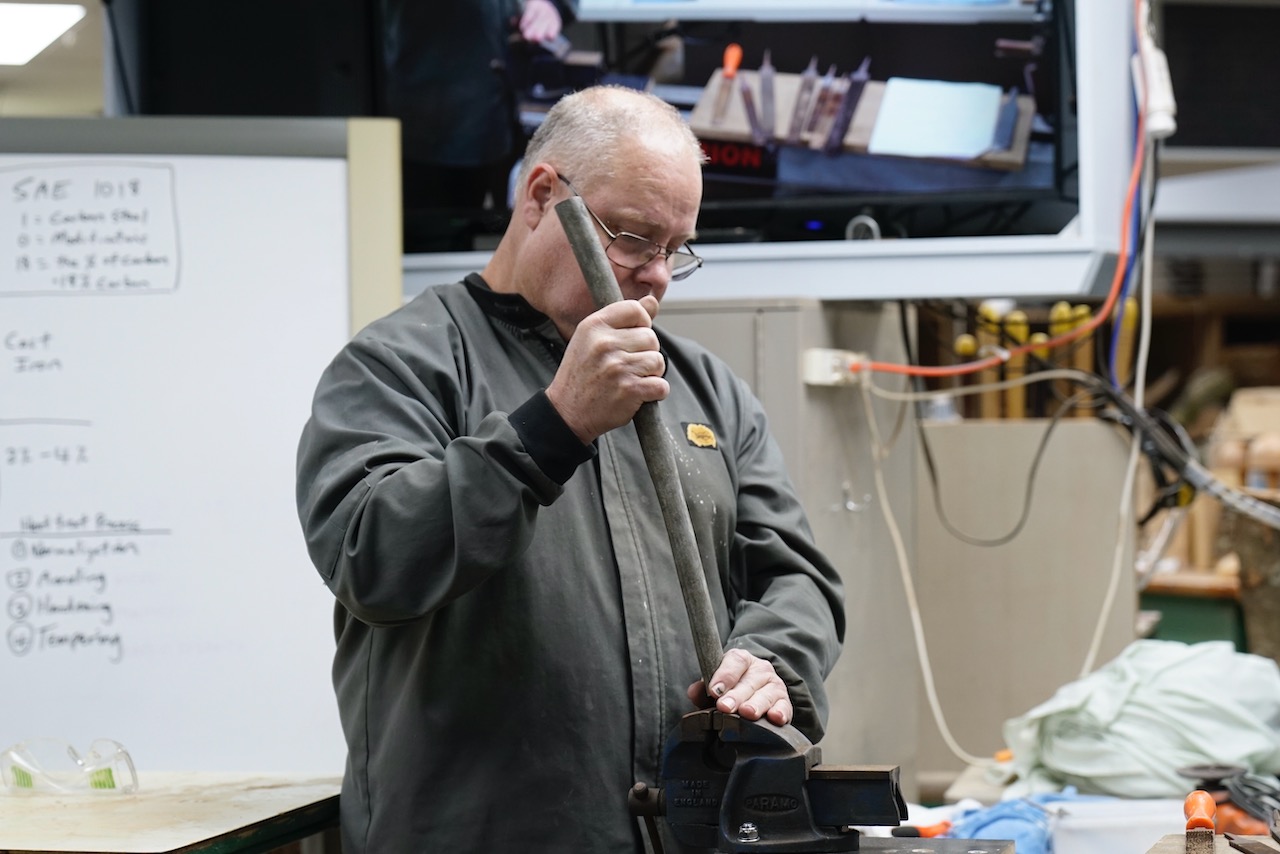
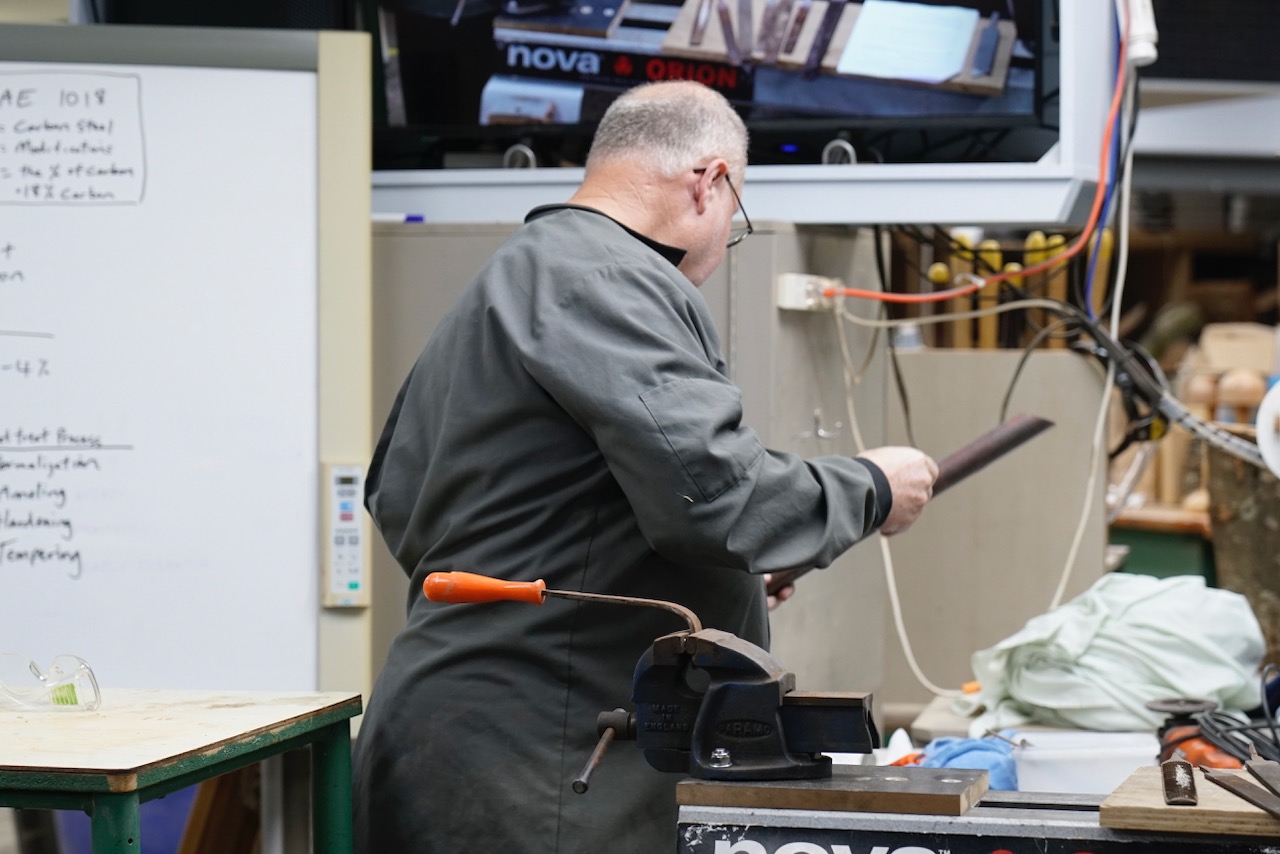
Having talked through the heat treatment process, it was appreciated that most of us do not have a forge. Jon introduced us to a source of steel which is already hardened and readily available at home. This is the humble file. The home-made tools that Jon passed around at the beginning of his demo were all made from files. He explained that not all files are suitable but it is easy to work out which ones are by gripping the file in the vise and trying to bend it. It will either break cleanly or it will bend. If it breaks you will be able to see if it has a fine grain structure or a coarse grain. The file you should use should have a fine, even grain structure. For the record, files are described by their types as follows:
- The through hardened file – clean break with very fine grain, this is the file you want to use for the tool.
- Fools through hardened file – clean break but coarse grain, no good.
- Soft as butter file – bends easily (typically rasps), no good.
- Case hardened file – bends easily. These are typically files that cut metal, but are no good given their soft as butter interior.
How do you shape your tools? Use your angle grinder with a cut-off or skinny disc to make the basic shape. Use a grinding disc to tidy up the cuts and to add radius curves as required. Finish by using a flap disc or belt sander to remove mill scale and to make everything flat. If shaping a file it is very important to keep the file cool during these processes. Files are already hardened and any heat over the tempering temperature of around 200 degrees will soften the file and the tool will not hold an edge.
Once you have made your tool from a file, it still needs to be tempered. Jon’s suggestion is that this can be done in the home oven by heating at 200C for two hours and then allowing it to cool naturally in air on the bench.
Other suitable materials for tool making are HSS hacksaw blades and planer blades etc.
What is HSS? HSS stands for high speed steel. It is a high carbon steel with a range of additional elements such as tungsten, chromium, vanadium, cobalt, molybdenum etc. It is very hard, retains a good cutting edge (although it cannot achieve the sharpness of carbon steel), and it is more forgiving when overheated compared to carbon steels.
Jon’s presentation was successful in maintaining a very high level of audience interest throughout. It was delivered with high doses of humour and audience involvement, used easy to understand terminology and was well structured. Thanks a heap Jon.